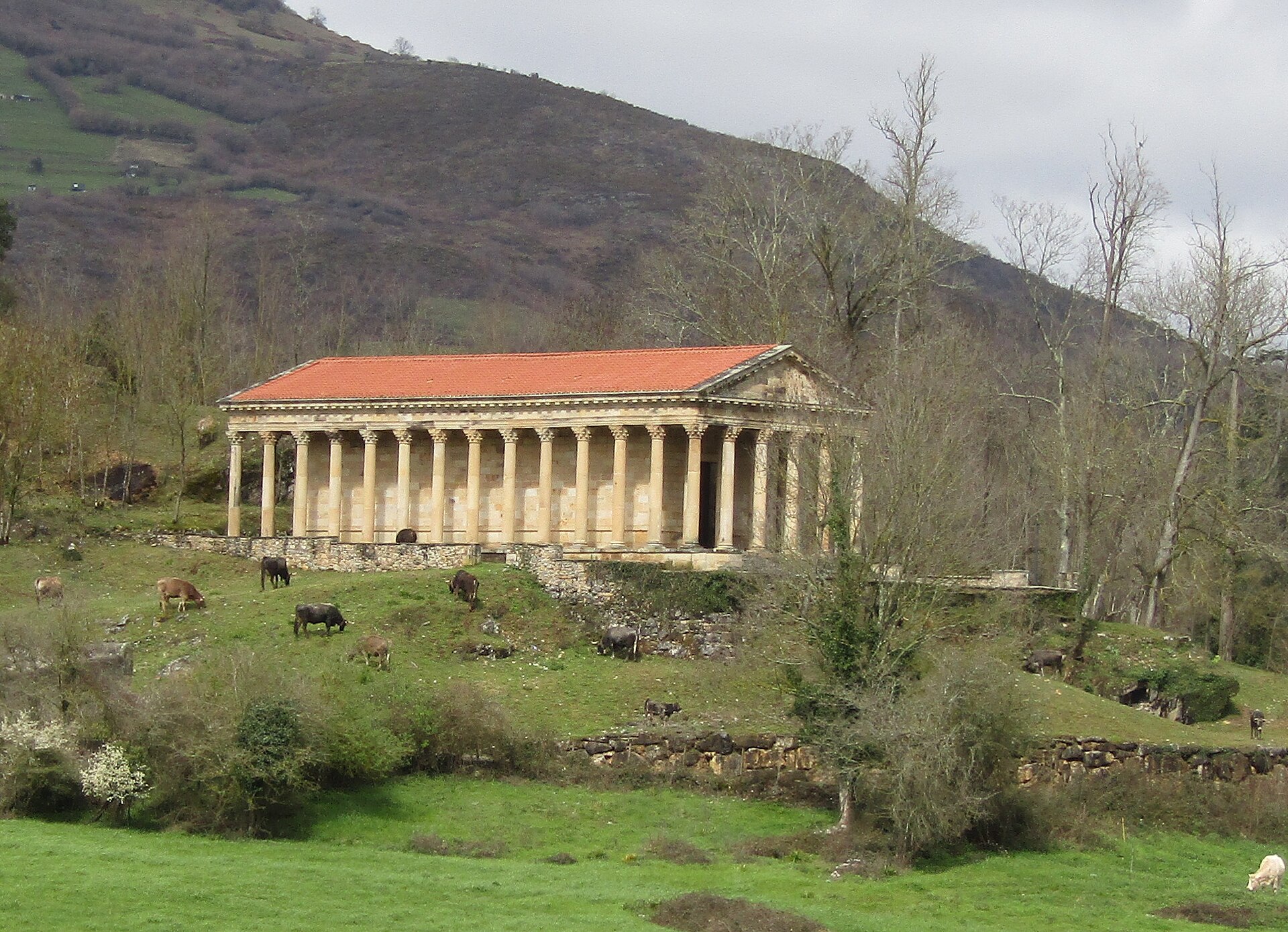
San Jorge Church stands on a small hill in Las Fraguas, within the municipality of Arenas de Iguña. Its Neoclassical profile, with Corinthian columns, an entablature and triangular pediment, stands out in the rural valley landscape. The town council dates the church to 1890, says it was commissioned by the Dukes of Santo Mauro, and notes its popular nickname, “El Partenón” (“the Parthenon”). The name describes its classical appearance; the building is not an archaeological replica of the Athenian temple.
At a glance
| Location | Las Fraguas |
|---|---|
| Municipality | Arenas de Iguña |
| Type | Religious heritage |
| Access | Exterior; check whether interior visits are available |
A funerary chapel that became a parish church
The building was originally a funerary chapel associated with the Dukes of Santo Mauro. The family later donated it to the people of Las Fraguas for use as a parish church, a religious purpose recorded by the town council. Its heritage page gives 1890 as the construction date and links the project to the dukes’ wishes. We have not found a building record that would justify adding an architect, budget or more precise chronology.
The site is associated with an earlier medieval hermitage. The town council says the present church was built over its remains. The 2026 heritage inventory records this tradition but also notes that an archaeological review in 2007 found no evidence of earlier structures in the current building. Together, these sources point to a possible connection with an older religious site, but do not confirm that its walls survive beneath the 1890 church.
The inventory also cites a 1119 reference to “S. Gregorii de Collantes” and relates it to the area’s religious history. That medieval mention cannot automatically be identified with today’s church, nor does it prove that the current San Jorge building existed at the time. Románico Digital documents another clue: a Romanesque capital once kept near the dukes’ chapel and described in a 1979 study by García Guinea. The publication says the capital had disappeared by the time its account was written. It is a lost object, not a feature visitors can currently look for at the site.
Neoclassical architecture in a Cantabrian landscape
The church has a rectangular plan and is surrounded by forty Corinthian columns, according to the town council. Its composition includes an entablature, cornice and triangular pediment. This classical architectural vocabulary creates a deliberate contrast with the villages and meadows of the valley. San Jorge is consequently regarded as one of Cantabria’s most distinctive Neoclassical buildings and a visual landmark of Las Fraguas.
The nearby Palace of Hornillos means San Jorge is often included in heritage walks around the village. The palace’s architectural ensemble stands on a private estate. A public road or municipal route passing by the church does not grant permission to enter the property or its gardens. Distinguish the two sites and use only public paths and spaces.
The 2026 inventory includes heritage-catalogue and planning-protection references for the location, while distinguishing the 19th-century Neoclassical building from medieval remains or references. This guide does not describe the church as a Bien de Interés Cultural (Asset of Cultural Interest): the sources consulted do not establish a BIC declaration for this church. Any conservation or works application should be checked against the current catalogue and relevant legal resolution rather than inferred from an abbreviated entry.
A stop on a Las Fraguas walk
The town council includes San Jorge in its Paseo Palaciego and Rincones de Valdeiguña routes. Its route guide places the church on a hill beside the local road towards San Vicente de León. This is a walking suggestion, not confirmation that the building is open to visitors or that every section remains in the same condition as when the guide was prepared. Check current municipal information before setting out and take care where the route follows a road.
The town council’s description mentions images of San Jorge and San Roque that belonged to the former parish church. We cannot confirm that they remain at a particular location: the description gives neither their present whereabouts nor visiting arrangements. No regular opening hours, guided tours or interior access have been verified. To attend a service, contact the parish; at other times, view the church from a public place and respect any closures.
Frequently asked questions
Why is it called El Partenón?
The popular nickname refers to its Corinthian columns, entablature and triangular pediment. It remains a 19th-century church, not an ancient Greek temple.
When was it built?
The town council dates the present church to 1890 and says the Dukes of Santo Mauro commissioned it as a funerary chapel. A possible earlier medieval hermitage is a separate feature, and its archaeological connection to the present building has not been confirmed.
Can visitors go inside?
We have not found published tourist opening hours. The municipal walking route passes the site but does not guarantee that the church is open. Check access before travelling.
Can visitors enter the Palace of Hornillos estate from the church?
Do not assume that they can. The palace and its estate are private; use public roads and respect gates and closures.
Sources and scope
The 1890 date, the dukes’ role, the forty columns and the donation for parish use come from the town council’s religious-heritage and presentation pages. Its walking-route page locates the church on local routes. The 2026 heritage inventory and Románico Digital provide context about the earlier church and the missing capital; these clues are not presented as proof that the present building contains medieval fabric. An older claim that the building served as a prison during the Spanish Civil War has been removed because no reliable support was found in the sources reviewed.
Sources: Arenas de Iguña Town Council · Religious heritage ↗, Arenas de Iguña Town Council · About the municipality ↗, Arenas de Iguña Town Council · Walks and routes ↗, Arenas de Iguña Town Council · Cultural heritage inventory, record 4.3 ↗ and Románico Digital · Las Fraguas and the missing capital ↗.
More to see in Las Fraguas
This guide is part of the Las Fraguas locality page, which gathers the village’s other places, routes and celebrations.
Return to Las Fraguas ES or explore the whole municipality in the Arenas de Iguña travel guide.