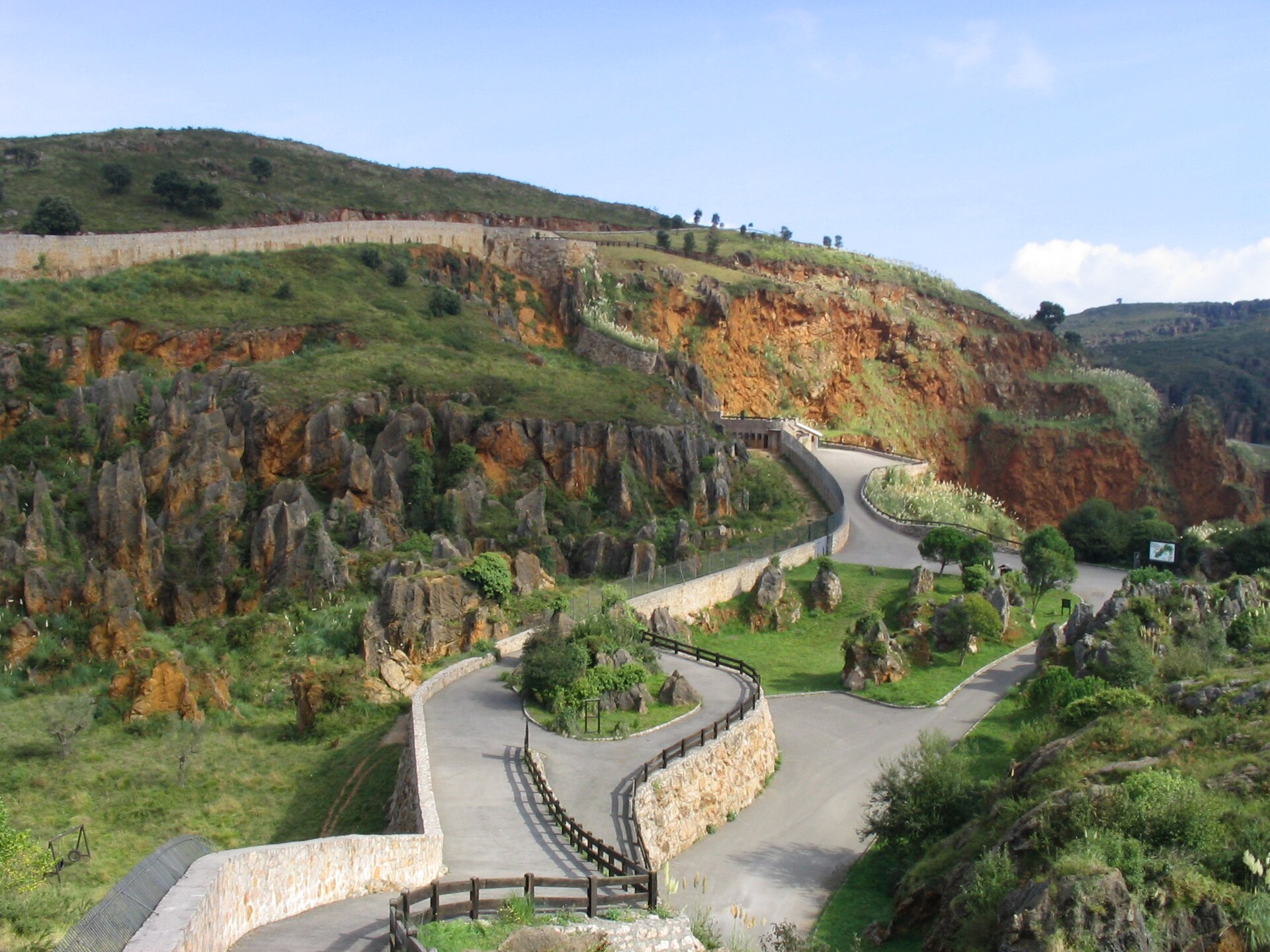
Cabárceno Nature Park occupies a former iron-mining site and combines large zoological enclosures with a karst landscape profoundly reshaped by human activity. The park extends across several municipalities: part of it lies in Penagos, but the whole site does not belong to this town.
Key facts
| Location | Territory shared by several municipalities; part lies in Penagos |
|---|---|
| Municipality | Penagos |
| Type | Nature park and landscape |
| Admission | Paid entry; check the operator’s current opening times and rules |
History and setting
The local council puts the park’s area at around 750 hectares and describes roads, viewpoints, recreational areas and botanical routes. These figures and services may change with works or management, so check with the operator before planning your day.
The red, rugged landscape, limestone pavements and dolines reflect the dissolution of limestone and the mining history of Peña Cabarga. Environmental restoration gave a tourist and conservation purpose to an area deeply altered by mining, but the park remains a managed facility with designated visitor areas and its own restrictions.
Current safety rules are essential: use authorised entrances, respect fences and signs, and do not feed or approach the animals. Traffic rules, demonstrations, special visits and opening times vary by season.
Planning your visit
Check the calendar, admission prices and visitor conditions on the operator’s official website before setting out. Entry is paid, and the surrounding territory is shared with neighbouring municipalities.
Access and safety
Do not assume that former mine buildings or other spaces are open to visitors. Check what is currently accessible and respect private property. There is no confirmed tourist access to abandoned shafts, galleries or mining structures.
A former mine turned into a nature park
Cabárceno Nature Park occupies part of the Peña Cabarga massif, which was transformed by iron extraction. The karst terrain, reddish rock outcrops and limestone dissolution features tell a story of industry that predates the park. Environmental restoration gave a new tourist and educational purpose to a landscape exploited as a mineral resource for centuries.
The site crosses more than one municipality. Part lies in Penagos and another part in neighbouring areas; “Cabárceno” can mean the village, the mining landscape or the park, but it does not mean that the entire park belongs to the village. This guide distinguishes those meanings so that local history and visitor information are not confused.
Routes and wildlife viewing
The municipal information describes large enclosures, internal roads, viewpoints, recreational areas and botanical routes. Check the official operator for open areas, circulation arrangements and activities that can be booked. Avoid planning your visit around times copied from old articles: exhibitions, services, access and safety measures change with the calendar and any works.
Responsible wildlife viewing means keeping your distance and following barriers. Do not feed animals, leave your vehicle where prohibited, touch fences or try to enter through gates or unmarked paths. The park’s rules protect both visitors and animals, and on-site signs take precedence. The park continues to maintain and improve its infrastructure, so routes may change.
Cabárceno and Penagos’s mining history
Iron mining left behind changes to the landscape and remains of activity, rather than just one isolated building. Uneven ground, rock cuttings and exposed materials make the cumulative impact of mining visible. Penagos council and the Valles Pasiegos association connect the Tobalina and Crespa workings with the municipality’s history. Access to shafts, galleries, ponds and abandoned structures is not assumed to be open or safe; do not enter or approach them.
The story of environmental recovery should be read alongside the memory of mining work that changed the landscape and local economy. Cabárceno is more than a collection of animals or a geological backdrop: it is also a historic, working territory with nearby villages and paths. Visits to the park itself, however, take place within the boundaries set by its operator.
Conservation, education and recreation
The municipal council presents the park as a place for education, science, culture and recreation. Species totals and area figures published at different times may vary. This guide does not reproduce the animal list from a 2013 page because animal groups, births, transfers and conservation programmes change. For current species and projects, consult the park and CANTUR.
Demonstrations and educational activities have their own schedules, booking arrangements and conditions. This guide does not give prices, phone numbers, opening times or age limits taken from old leaflets. Before travelling, confirm the date, duration, meeting point, accessibility and available services through official channels. Check operational notices too if heavy rain or extreme temperatures are forecast.
How to plan a visit
The size of the site makes it worth setting aside enough time and checking the official map in advance. Use the entrance that corresponds to your ticket and do not use alternative access points. If travelling with children, agree on a meeting point and explain the rules around barriers. Follow posted speed limits and do not stop where you might obstruct traffic or emergency services.
You can visit Penagos’s villages at another point in your trip. Its churches, bridge and palace are outside the wildlife park and are not included with park admission. Check actual travel times; do not assume that a road inside the park can be used to reach local heritage sites.
Frequently asked questions
Is all of Cabárceno within Penagos?
No. The park extends across neighbouring municipalities. The municipal guide notes this territorial division.
Can you explore the park on foot or by bicycle?
Rules vary by area and date. Check the operator’s current information before planning a visit without a car.
What are the opening times and prices?
They change, so they are not fixed here. Check the official website and current notices.
Can you visit the old mines?
Tourist access to galleries, shafts and abandoned mining structures is not confirmed. Do not try to enter.
More to see in Cabárceno
This page is part of the guide to Cabárceno. It brings together other places, routes and celebrations associated with this locality.
- Church of San Vicente Mártir in Cabárceno (guide in Spanish)
Return to Cabárceno village or to the wider municipality of Penagos.
Sources: Official park website ↗ and Penagos council ↗.