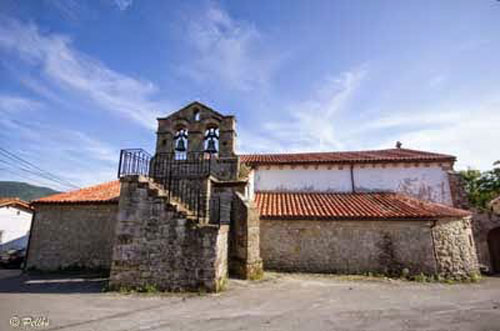
The Church of the Assumption is one of Bielva’s main heritage landmarks. The municipal environmental report says construction began in the 16th century and that the building retains features of Gothic architecture.
Key facts
| Location | Bielva |
|---|---|
| Municipality | Herrerías |
| Type | Heritage |
| Access | Exterior; check whether interior visits are possible |
History and details
The municipal description highlights a sanctuary covered by a vault with thick ribs and a nave with tierceron vaults. It also mentions a two-opening bell gable, decorated corbels and an exterior Gothic arcosolium. The old listing added details about the layout, bells, burials and altarpiece; each is retained only where the municipal heritage catalogue confirms it.
Planning your visit
This is an active place of worship. Interior visits are not assumed; respect services and contact the parish if you need access.
Access
Seeing the exterior does not mean that the building or site is open to the public. Check its current use and respect private property.
The church of Bielva and its historic centre
The Church of Our Lady of the Assumption is the main documented church in Bielva. The town council’s heritage leaflet places its construction from the 16th century onwards and notes that it retains Gothic features. This municipal dating replaces the broader 14th–16th-century range in the old listing. No architectural monograph has been found proving a complete church from an earlier phase, so the present building should not be described as a 14th-century construction.
The church forms part of the village’s historic landscape, alongside Bielva’s houses, paths and community spaces. The village served for many years as the municipal seat, but the administrative capital moved to Puente del Arrudo in 2002. The church should therefore be understood as a heritage site in Bielva, within the municipality of Herrerías; its presence does not make the village the current administrative capital or mean that all municipal services are located around the church.
Sanctuary, vaults and bell gable
The municipal description highlights a sanctuary covered by a vault with thick ribs and a nave with tierceron vaults. The ribs strengthen and visually divide the ceiling; tiercerons add diagonal lines crossing the main ribs. The town council’s tourism guide summarises these features but does not identify an architect, workshop or exact date for each phase. This guide explains the forms without attributing the work to a particular master or extending the date of one part to the entire church.
Outside, the two-opening bell gable stands out. The local leaflet describes decorated corbels with a cavetto profile and an exterior Gothic arcosolium. An arcosolium is a funerary niche built into a wall; its presence connects the building with burial practices and the memory of Bielva’s residents. It should not be confused with the nearby cemetery of slab-built graves, a separate archaeological feature.
The municipal environmental report also records a main altarpiece containing reliefs from an earlier 17th-century altarpiece. This points to a history of changes, but the source does not list individual panels or sculptures or date each piece. The guide stays within the information provided by the local source and avoids adding stylistic or authorship attributions from unconfirmed secondary websites.
The nearby cemetery is archaeological heritage
Beside the church is an unexcavated cemetery of slab-built graves, dated by the municipal leaflet to between the 9th and 12th centuries. These graves are formed by stone slabs delimiting the burial space. The group provides evidence of early medieval occupation around Bielva and predates the church building, which the town council dates from the 16th century onwards. Their proximity does not prove that the cemetery and present church originated together or that the graves belonged to a parish community organised exactly like the later one.
According to the municipal source, the site has not been excavated. This page gives no coordinates, describes no access and does not encourage visitors to search for graves or disturb the ground. Archaeological remains are vulnerable to trampling, unauthorised digging and removal of materials. If you notice changes in the soil or stones arranged in the ground, leave them in place and respect barriers, signs and property.
History and how to read the site
The Church of the Assumption helps distinguish two timelines in Bielva: medieval funerary evidence in the surroundings and the church construction documented from the 16th century. The architecture retains Gothic features, while the main altarpiece includes reliefs linked to a 17th-century work. These elements do not belong to a single phase; they reflect the continued use and renewal of a church that has served generations of villagers.
The setting also helps explain the scale of a rural settlement in the Nansa valley. The building is a landmark in the village and a place of worship, not a museum with permanent opening hours. An older tourism description said that it was open for worship, but this does not establish visitor hours or guarantee interior access at any time. If you hope to attend a service or see the altarpiece, contact the parish or town council beforehand.
Each village in Herrerías has its own religious heritage. The Church of the Assumption in Bielva is not the Chapel of Christ of the Remedies, which has its own listing, nor the Church of Saint Ignatius in Rábago, or the churches in Cades and Camijanes. Keeping these places separate helps visitors navigate and prevents stories, festivals or dedications from being assigned to the wrong village.
Planning a respectful visit
The church can be included in a walk through Bielva and its streets, provided you stay in public areas. As a place of worship, it may be open during services and closed at other times. Do not force doors or enter adjoining rooms. If a service is taking place, remain quiet, silence your phone and ask before photographing the interior or attendees.
The neighbouring cemetery requires particular care. Do not approach a supposed grave by unmarked paths or use commercial maps to search for an exact point. The municipal page presents the archaeological information in general terms to explain its significance, not to promote direct access to the site. Do not remove stones, touch structures, leave objects or publish images that reveal vulnerable access routes.
Take time to look at the church from its surroundings. First notice the outline of the bell gable; then, from a public and safe viewpoint, observe how the sanctuary, nave and attached volumes relate to one another. If the church is closed, the façade and village setting still convey its role. You can continue towards the Chapel of Christ, but the two buildings have different histories and access conditions.
Frequently asked questions
How old is the church?
The town council says construction began in the 16th century and that the church retains Gothic features. The old listing gave a broader 14th–16th-century range, which has not been confirmed by a detailed heritage source.
What can be found nearby?
The local leaflet mentions an unexcavated cemetery of slab-built graves dated between the 9th and 12th centuries. It is sensitive archaeological heritage; this page does not publish an access point.
Can visitors go inside?
No continuous visitor schedule has been verified. Ask the parish or town council and do not interrupt worship.
Which features are worth noticing?
The ribbed sanctuary vault, tierceron vaults in the nave, two-opening bell gable, corbels and Gothic arcosolium are the features identified in municipal documentation.
Sources and scope
The chronology, architectural description, altarpiece and cemetery are based on the municipal heritage leaflet and the Herrerías Environmental Sustainability Report. These sources describe specific features but do not provide a complete archaeological sequence or identify the builders. This page therefore revises the old dating, retains only confirmed details and distinguishes the church from the nearby cemetery. Worship times are not presented as tourist opening hours.
More to see in Bielva
This listing is part of the Bielva guide, which covers the other places, routes and celebrations associated with the village.
- Chapel of Christ of the Remedies in Bielva ES
- Festival of Christ of the Remedies in Bielva ES
- Christ’s Steps in Bielva ES
Return to Bielva ES or the Herrerías municipality guide.
Sources: View source ↗ and View source ↗.