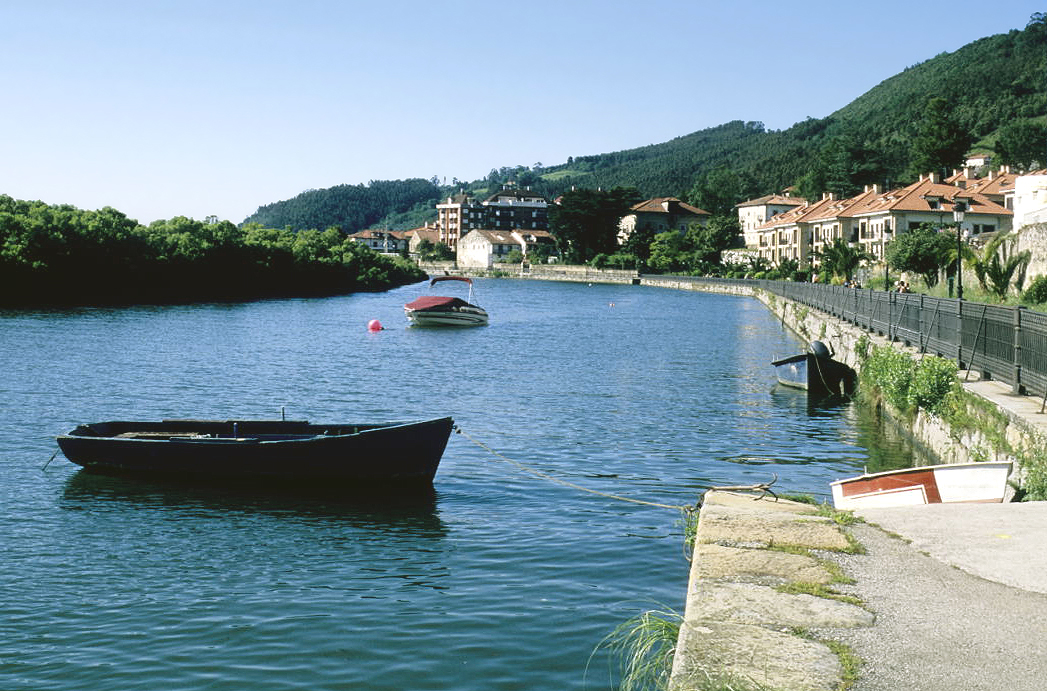
Rivero’s riverside quay and the Casa Lonja form a heritage complex declared a Bien de Interés Cultural in 2009. Beside the estuary, the site helps explain Limpias’s historic trade.
Key facts
| Location | Rivero neighbourhood, Limpias |
|---|---|
| Municipality | Limpias |
| Type | Heritage |
| Access | Exterior view; check before seeking interior access |
History and details
The stone quay follows the shoreline with ramps and steps. The Casa Lonja was built in 1732 using funds left by José del Rivero Palacio; it was used to store local goods and accommodate carriers and travellers. Heritage records describe a two-storey building with an open courtyard and a distinctive rounded corner. The designation protects the complex specified in the official file, not every building in the neighbourhood.
Planning a visit
An outdoor walk. Check the tides, ground conditions and any restrictions; do not enter closed buildings.
Access
Viewing a building or space from outside does not mean it is open to visitors. Check its current use and respect private property.
A river port linked to the hinterland
Rivero grew on the banks of the Asón estuary and served as an exchange point between the coast, the valleys and the Castilian plateau. Its importance rested on navigation and roads linking Limpias with Castile and the inland ironworks. Heritage records describe a port where agricultural produce and minerals were loaded, while iron and other goods arrived for redistribution.
The town council links port activity to iron carried from Biscay to the forges of Carranza, Soba and Rasines, as well as chestnuts, wheat, maize, fruit and chacolí wine. Volumes and routes varied over time and should not be reduced to the claim, repeated in some older accounts, that this was “Spain’s first inland port”. There is not enough evidence to support that national primacy; Limpias’s regional role and the official heritage records establish the site’s importance.
The Casa Lonja and quay
Work on the Casa Lonja began in 1732 with funds sent from Mexico by José del Rivero Palacio. The building stored iron from the forges and chestnuts, and also provided rooms for carriers and passengers and a public tavern. Its layout included an open courtyard and storage areas; one rounded corner gives the building its distinctive shape. The ashlar quay follows the riverbank with ramps and steps. Both structures form the Bien de Interés Cultural declared by the regional Council of Government in 2009.
The designation defines a setting intended to preserve the visual relationship between the exchange house, the quay, nearby buildings and public space. It does not extend BIC status to every house in the neighbourhood. The Casa Lonja must be distinguished from the residential palace of Roque del Rivero Palacio, built for a different person and purpose. Older pages on this site had conflated the two histories; they are treated separately here.
From commercial port to riverside walk
The port’s commercial activity changed as transport links around the estuary evolved. The town council identifies the construction of Treto’s swing bridge in 1905 as one factor in this change. Today, the quay and exchange house can be viewed from public areas and are part of a walk beside the estuary. Small boats and changing tides are reminders that the place remains closely connected with the water.
The quay is beside the estuary; it is not a tourist landing stage with a ferry service to Viar Island. Do not board a vessel or attempt to reach the tidal mills on your own. Check the tide and stay in permitted areas; the stone paving and ramps can be wet or slippery. Heritage protection supports the conservation and outdoor enjoyment of the complex, but does not guarantee access inside the Casa Lonja.
More places to see in Limpias
This page belongs to the Limpias guide, which lists the other places, routes and celebrations in the town.
- Spanish Navy Museum Park
- Limpias sword collection
- Palace of the Count of Albox and El Castañar estate
- Otero Tower, or the Clock Tower
Return to Limpias or to the Limpias municipality guide.