Discover Limpias
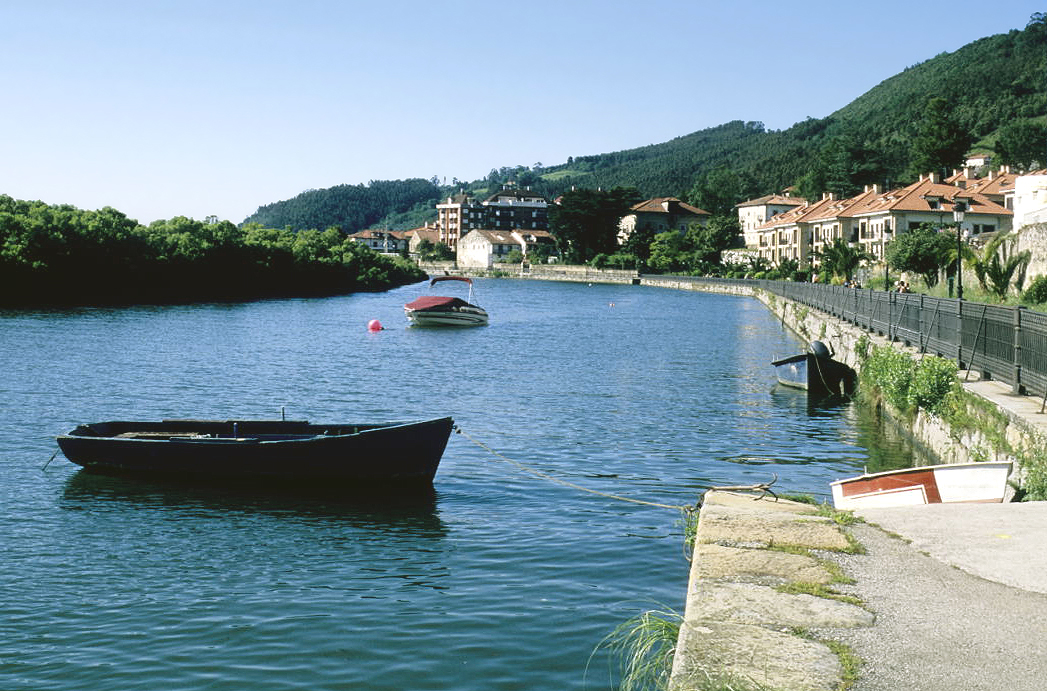
Limpias is the municipal centre, extending beside the Asón estuary. Its port history can be seen in the Rivero neighbourhood, where the quay and Casa Lonja form a protected heritage group. The church of San Pedro in Rucoba is home to the Cristo de la Agonía shrine; palaces, historic houses and the Clock Tower stand in other neighbourhoods. The sights are spread out, so check their location on a map and confirm access conditions before travelling between them.
The Casa Lonja recalls the legacy sent from Mexico by José del Rivero Palacio in 1732 and the port-related uses of storage and accommodation. It should not be confused with the palace built shortly afterwards for Roque del Rivero Palacio: municipal information documents them as separate buildings. Around Rivero, Limpias tourism also identifies the Casa de Diego de la Piedra and Casa de Pereda, two adjoining houses that can be viewed from public spaces; indoor visits are not confirmed here.
Torre de Otero, or Clock Tower
The clock stands on a rise about 84 metres above sea level. Reconstruction of the freestanding tower began around 1844 as a civic belfry and public clock; its bells could be heard in nearby settlements. The official file records historic repairs and conservation work in 2015. A new procedure to designate it a Site of Local Interest began in 2026. This gives it provisional protection, but the final designation still requires completion of the process.
Espina: aqueduct and walk
The Espina Aqueduct, built of masonry with several arches, formed part of water-supply works that the municipal source dates to the early nineteenth century. The neighbourhood’s history can be explored along the estuary on the Remigio promenade towards Costamar. Limpias tourism publishes a family-friendly circular walk to the Clock Tower and a roughly three-kilometre out-and-back estuary walk; check the surface, works, tide and current conditions before setting out.
Tidal mills and activities
La Grazosa stands on Viar Island in the middle of the estuary; the town council explains that it was reached from Limpias by water. The Angulo mill, also known as Magefesa, is at Costamar, where the same source notes damage caused by tides. Neither site should be treated as an indoor attraction or as having guaranteed safe access. The municipal website also promotes birdwatching, canoeing and paddleboarding through local organisations and businesses; confirm they are operating, and check booking and safety requirements directly.
The Camino Real and local celebrations
The Camino Real linking Laredo and Burgos crossed the municipality and features in the history of trade between Castile and the coast. Limpias tourism records the local tradition that Charles V travelled this road in 1556; it is presented here as a municipal historical account. Local celebrations include San Isidro in Rucoba, San Pedro in the town hall square, Santa Isabel in Espina and Santo Cristo at the Rucoba church. Dates and activities listed by the tourism portal should be confirmed each year with the town council and parish.
Photograph: Source ↗ · Source ↗.
Places, walks and festivals
- Rivero quay and Casa Lonja
- Spanish Navy Museum Park
- Limpias sword collection
- Palace of the Count of Albox and El Castañar estate
- Torre de Otero, or Clock Tower
- Limpias springs and waters
- Church of San Pedro and Shrine of the Cristo de la Agonía
- San Roque Chapel
- Chapel of La Piedad, or Santa Isabel
- Former San José School
- Former San Vicente de Paúl School
- Casa Torre de El Palacio
- Casa Rucoba, or Torre del Pico, in La Dehesa
- Palace of Roque del Rivero Palacio
- House of Don Juan Cosme de Albo
- Santa Isabel Festival in Limpias
Sources: Source ↗, Source ↗, Source ↗, Source ↗, Source ↗, Source ↗, Source ↗, Source ↗, Source ↗, Source ↗, Source ↗ and Source ↗.