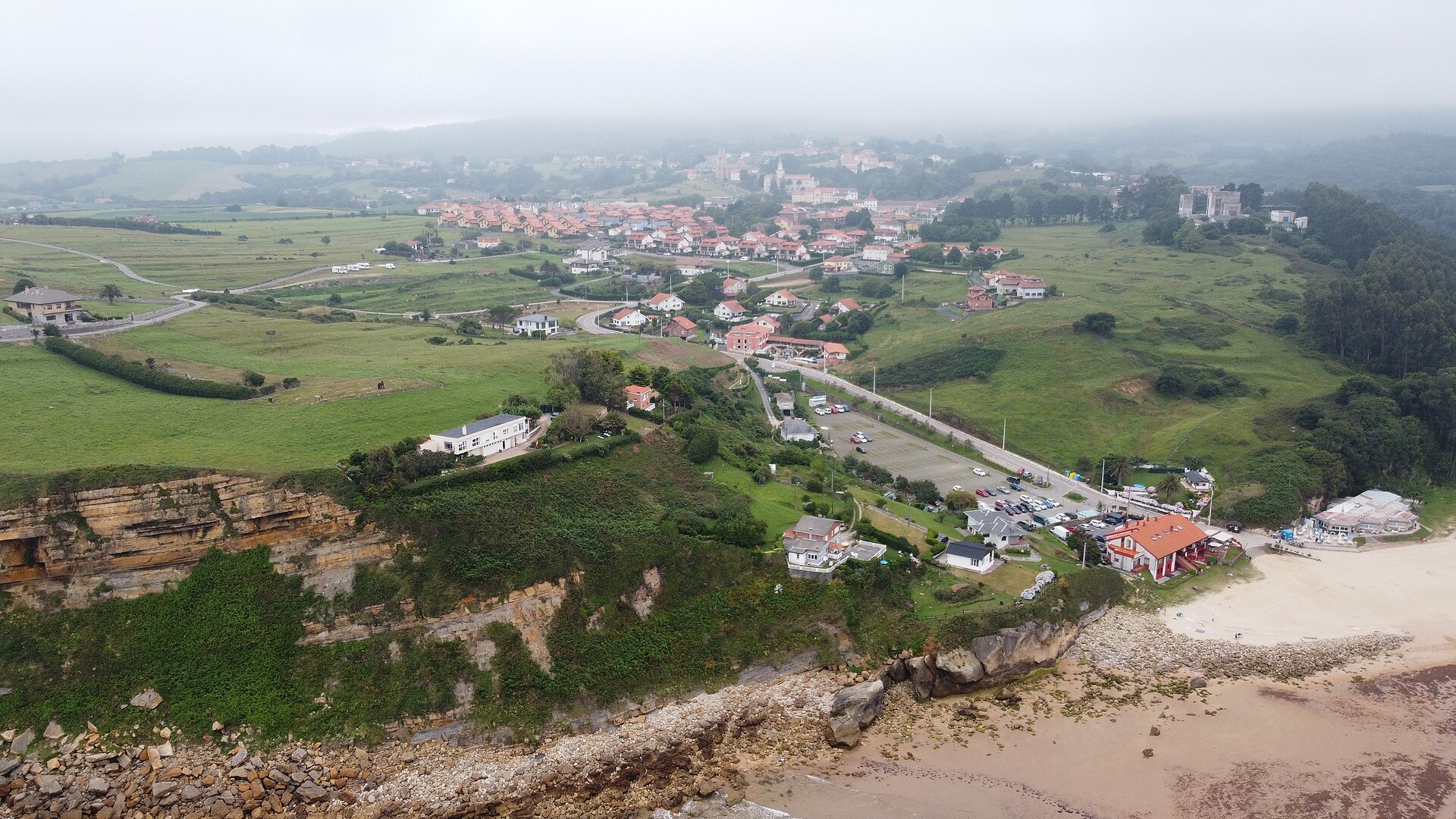
Santa Ana Hermitage stands in the upper part of Cóbreces, in the El Pino neighbourhood. The municipal heritage catalogue dates its foundation to the sixteenth century and links it to the Villegas family; renovation in the late nineteenth century gave it the neo-Gothic appearance described in the record. It has a two-bay nave with rib vaults, a three-storey tower and an eighteenth-century altarpiece. The local feast is held on 26 July. The chapel remains part of religious life, but no regular tourist opening hours are published.
In the upper part of Cóbreces
The hermitage belongs to Cóbreces, one of the seven villages of Alfoz de Lloredo, and is located in El Pino. Its position above the village connects it with the neighbourhood and historic houses spread across the different quarters. It should not be confused with the neo-Gothic parish church of San Pedro Ad Víncula, built in the late nineteenth century elsewhere in Cóbreces, or with San Roque Hermitage, which the municipal catalogue places in Luaña.
The protected-elements catalogue of the municipal development plan identifies Santa Ana as entry 1.42 and locates it in El Pino. The town’s tourism page describes it more generally as a church in the upper part of the village. The map at the end of this page gives a location reference; it does not imply guided visits, parking by the door or public access to the interior.
The hermitage is part of a locality with several religious centres from different periods. The parish church, Viaceli Abbey and the chapels of Santa Ana and San Roque have distinct histories and uses. When visiting Cóbreces, consider each as a separate place and do not attribute features from one building to another.
A sixteenth-century chapel remodelled in the nineteenth century
The town’s heritage sources date Santa Ana’s foundation to the sixteenth century and associate it with the Villegas family of Cóbreces. The planning catalogue describes it as built in that century by order of the family and renovated in the late nineteenth century. It says those works changed the appearance and produced the present neo-Gothic style.
An older page on this website said that the hermitage had been built “around the seventeenth century” by Antonio Villegas. That account does not fully match the municipal catalogue, which places the construction in the sixteenth century. This revised guide follows the more specific date in the heritage inventory and records the older claim as an attribution without independent corroboration. Antonio Villegas is not presented as a proven architect or builder.
The catalogue dates the renovation to the late nineteenth century but gives no exact year, architect or breakdown of the works. A complete sequence between the original building and its current appearance therefore cannot be reconstructed. What is documented is a sixteenth-century chapel whose later renovation transformed it towards the neo-Gothic style; the date of individual features remains uncertain.
A vaulted nave and a tower beside the north façade
The planning record describes a nave divided into two bays and covered by rib vaults. Arches and crossing ribs organise the interior and draw the eye towards the sanctuary. The record does not provide measurements or a plan in the consulted text, so no dimensions or orientation are added here.
The walls are built of rubble masonry. The catalogue highlights well-cut ashlar stone at the corners, buttresses and main façade. The buttresses strengthen the walls and help carry the thrust of the vaults. The combination of rubblework and dressed stone makes the structural supports particularly legible.
The main façade has neo-Gothic features associated with the nineteenth-century renovation. The town hall highlights the doorway and a large window topped by a rose window. The catalogue also describes a three-storey ashlar tower attached to the north façade. Narrow windows open on the two lower levels; the belfry is on the upper floor.
The tower has a hipped roof crowned by a pyramidal metal structure. The 2015 inventory noted that its clock was not working at that time. This is a record from 2015, not a current inspection. No recent source has been found to confirm whether the clock remains stopped or has been repaired.
The neo-Gothic renovation did not erase the earlier history. The sixteenth-century foundation, later restoration and features from different phases form a layered building: an old chapel given a façade in keeping with nineteenth-century historicist tastes. This interpretation follows the municipal inventory; no specific architect is named because the source does not identify one.
The altarpiece and devotion to Saint Anne
According to the municipal catalogue, the interior contains an eighteenth-century altarpiece. The current town tourism page describes it as Baroque in the Solomonic style, characterised by spiral-shaft columns. This attribution is retained as the municipality’s description; no author or more precise date is added without documentary evidence.
A diocesan report from July 2026 says the image of Saint Anne was carried in procession from the hermitage to the parish church of San Pedro Ad Víncula for the feast-day Mass. This confirms the devotional use of the image and the connection between the two churches during that year’s celebration. It does not establish that every image mentioned in older sources is still kept in the chapel, or that the interior opens outside religious events.
The altarpiece and images belong to a place of worship, not a museum with confirmed visitor hours. If the door is closed, respect that. Ask the parish or town hall about access to the interior or a particular service before travelling.
Saint Anne’s feast on 26 July
The town hall lists Saint Anne on 26 July in its calendar of popular festivals in Cóbreces. The general listing mentions Mass, picayos folk dancing, children’s games, a romería and an evening dance. This describes activities associated with the festival in the municipal calendar; each year’s programme may change and should be checked for the intended visit.
A report published by the Diocese of Santander on 23 July 2026 gives a recent, more specific example. On Sunday 26 July, the image was due to be carried in procession from the hermitage to the parish church at 12:15, followed by Mass at 12:30. The programme ended on Monday 27 July with the image’s return to the hermitage after a 21:00 Eucharist. These were the arrangements for 2026, not guaranteed times for later years.
The liturgical feast of Saint Anne falls on 26 July, when the Church also commemorates Saint Joachim. In Cóbreces, the religious calendar is combined with local events, but processions, performances and routes are announced edition by edition. Check current municipal and parish notices before attending; processions may temporarily affect traffic or street access.
Heritage protection and limits of the available information
Santa Ana Hermitage appears in the Alfoz de Lloredo PGOU protected-elements catalogue with comprehensive protection. The catalogue says all features defining the building must be preserved. Its 2015 record identifies church ownership and religious use, and describes the condition as good. That assessment is from 2015 and is not a recent inspection.
Inclusion in the municipal catalogue does not by itself amount to an individual declaration as a Bien de Interés Cultural (BIC) or Bien de Interés Local (BIL). The supported designation is comprehensive protection under the municipal planning rules. Applicable regulations govern any works; the competent authorities and church ownership should be consulted.
The 2015 official bulletin inventory is especially useful because it brings together the chronology, interior layout, materials, tower, altarpiece and protection regime. It does not, however, provide current opening hours, accessibility, later restoration details, visiting conditions or the present state of the clock. These points are left open rather than inferred.
Approaching the chapel and exploring Cóbreces
Santa Ana can be included in a visit to Cóbreces alongside San Pedro Ad Víncula church, the Cistercian Abbey of Santa María de Viaceli, San Roque Hermitage, the former San Felices and San Pedro monastery, Casal del Castro and the coastal landscapes of Luaña and Bolao. Each place has its own page and access conditions. Being close within the same village does not mean that every interior is open.
The period around 26 July is the best time to experience the Saint Anne tradition, provided that the current year’s programme confirms the events and access. At other times, the building may be viewed from public space where the road and conditions allow. No regular visiting hours have been found. Do not cross property boundaries or interrupt worship to take photographs.
The map is for orientation. Check road conditions and local signs before setting out, and park only where permitted. The consulted sources do not describe reserved parking, step-free access or public services beside the hermitage. If these matter to your visit, confirm them with the town hall.
Getting there
The heritage catalogue places Santa Ana in El Pino, Cóbreces. The map helps locate it within the village, but does not indicate parking availability or guarantee that the interior is open.
Get directions with Google Maps ↗
Frequently asked questions
Where is Santa Ana Hermitage?
It stands in El Pino, in the upper part of Cóbreces, in the municipality of Alfoz de Lloredo.
When was it built?
The municipal catalogue dates it to the sixteenth century and says it was renovated in the late nineteenth century. An older page on this website suggested around the seventeenth century; the difference is attributed to the sources and is not presented as resolved.
Can visitors see the altarpiece?
The catalogue confirms an eighteenth-century altarpiece, but no public interior visiting hours are available. Ask the parish or town hall before planning to enter.
When is the Cóbreces Saint Anne festival?
The town hall gives 26 July. Specific events and times can change annually; the diocesan 2026 programme describes that edition only.
Sources: View the municipal source ↗, View the official bulletin entry ↗, View the municipal festival calendar ↗, View the diocesan programme ↗ and View the earlier page ↗.
More places to see in Cóbreces
Continue to the Cóbreces guide ES for more of the village’s attractions.
- Santa María de Viaceli Abbey ES
- Casal del Castro manor house and chapel
- Villegas tower house
- San Roque Hermitage
Return to Cóbreces ES or explore the wider Alfoz de Lloredo municipality.