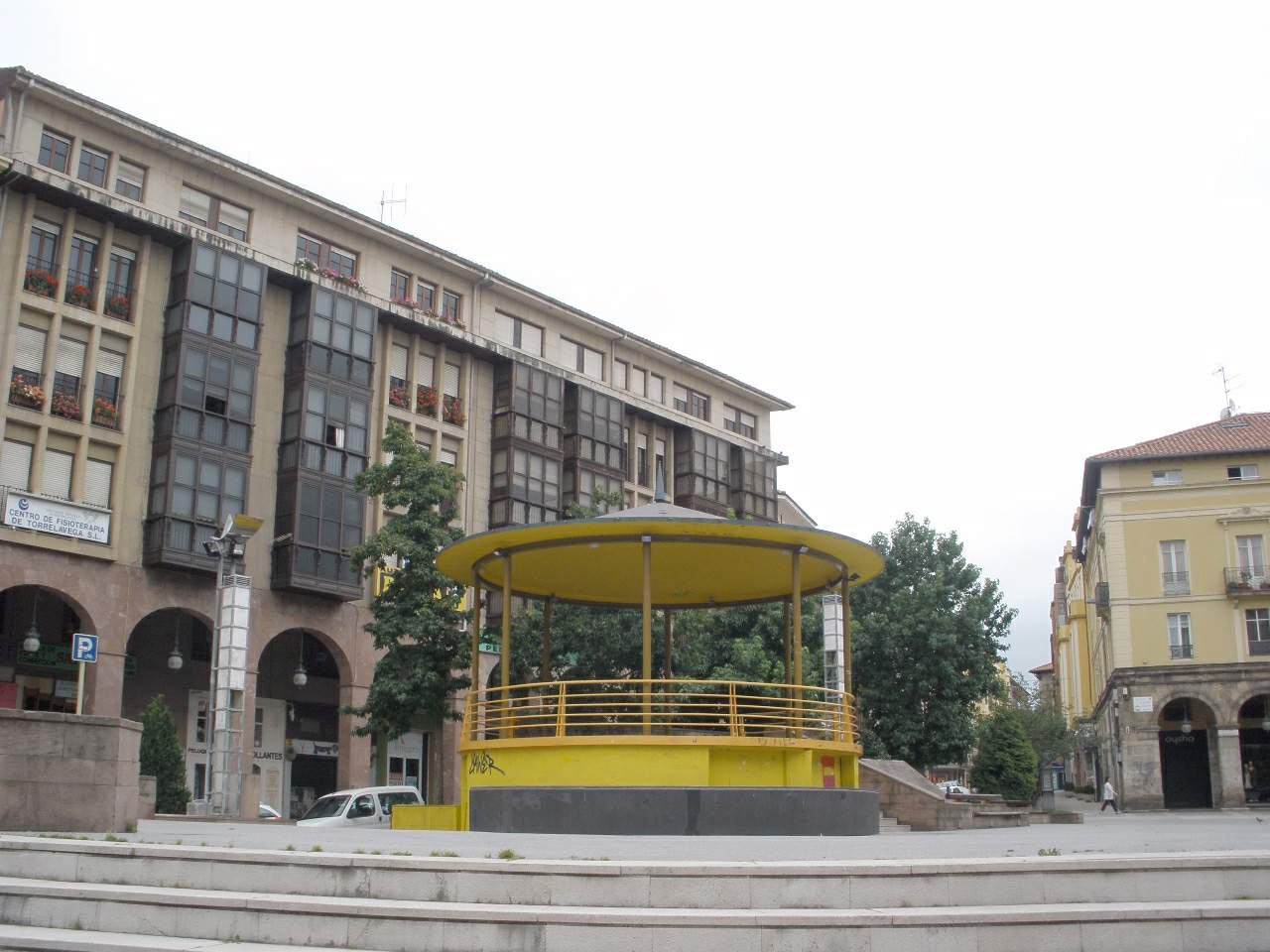
Torrelavega’s Plaza Mayor, also known as Gilberto Quijano Square, retains arcades dating from the 19th century and continues to host commercial activity. According to the town council, an organic market is held here on Saturdays; the historic livestock fairs moved to other venues in the city.
At a glance
| Place | Torrelavega |
|---|---|
| Municipality | Torrelavega |
| Type | Urban public square |
| Access | From public spaces |
History and background
Pasea Torrelavega describes the arcades as a 19th-century work, designed by Demetrio Herrero under the direction of Joaquín Rucoba. The 1854 Gazeta de Madrid reproduces the 1767 Royal Decree authorising a weekly market and the 1799 agreement concerning the jurisdiction’s revenues. A local chronology places the first market, on 4 July 1799, in the small square in front of the Casa Mesón, which it identifies as the origin of Plaza Mayor. That location is attributed to the local source; the legal record does not itself identify it. In 1844 a fortnightly livestock market became established in La Llama square; later, the National Livestock Market opened in 1973. This guide distinguishes those sites so that Plaza Mayor is not mistaken for today’s livestock-market venue.
The town council now includes Plaza Mayor in its commercial information: every Saturday the arcades host the Organic Market, with local and regional produce. The municipal events calendar also lists the Puff Pastry Fair around one of the weekends of the Virgen Grande festivities, with stalls and activities in the square. Dates, opening times and programmes vary, so check current official information before travelling.
Plaza Mayor, also known as Gilberto Quijano Square
Plaza Mayor is one of Torrelavega’s central public spaces and a useful landmark on a walk through the city. It is also known as Gilberto Quijano Square, a name found in municipal cultural material. Its scale, arcades and everyday activity distinguish it from a monumental square designed only as a historic setting: this is an urban place that remains part of local commerce and public life.
This guide retains the familiar name used in the historic URL, Plaza Mayor de Torrelavega, and adds the alternative name to make the place easier to identify. The municipal heritage guide dates the arcades to the 19th century and attributes their design to Demetrio Herrero, under Joaquín Rucoba’s direction. These details come from the local tourism leaflet; this research did not locate building plans or an architectural file that would establish further phases, alterations, measurements or attributions.
As you walk through the square, notice the continuous line of arcades and how it relates to the façades and shop entrances. The architecture creates a covered edge around the open space and shows how a square can bring together movement, shopping and meeting. This reading of the ensemble does not require entering private buildings and does not assume that every shop remains open or unchanged over time.
A square in the history of markets
The market’s history includes several dates that should be kept distinct. The 1854 Gazeta de Madrid cites a Royal Decree of 4 September 1767 granting Torrelavega the right to establish a weekly market, and an agreement of 9 June 1799 between the towns in its jurisdiction regulating how its proceeds were shared. A local chronology places the first weekly market on 4 July 1799 in the small square in front of Casa Mesón, which it considers the origin of Plaza Mayor. This location is attributed to that local chronology; the 1854 legal text confirms the authorisation and agreement but does not itself name the small square.
The documentary sequence therefore distinguishes the 1767 authorisation, the 1799 agreement and the site that local history associates with the square. None of those dates establishes when the surviving arcades were built: the municipal cultural leaflet places them in the 19th century. Nor should the square be confused with the fortnightly livestock market established in La Llama in 1844 or with the present National Livestock Market, which opened in another venue in 1973.
Municipal records specify that a fortnightly livestock market was established in La Llama square in 1844. This is a different place. The later National Livestock Market also has its own site: the town council dates its opening to 27 June 1973. These references help explain the city’s commercial development, but they do not turn Plaza Mayor into the site of current livestock fairs or transfer La Llama’s dates, facilities or services to it.
The distinction matters when planning a visit. Plaza Mayor may feature in city walks and commercial events; livestock activity takes place at the dedicated National Livestock Market, whose calendar is published by the town council. This guide keeps the sites separate. Historical dates remain attached to the locations named by the sources, and current activity is described only for the place where it takes place.
Organic market and temporary events
The town council’s Fairs and Markets page lists an Organic Market on Saturdays beneath the arcades of Plaza Mayor, with local and regional produce. This recurring commercial activity offers another way to experience the square: its arcades still shelter stalls and direct contact between producers and the public. The precise range of stalls, products and opening times can change with the season, public holidays, construction work or organisational decisions. Check current municipal information before making a special trip.
The town council has also announced the Puff Pastry Fair as part of the Virgen Grande festivities, with activities in Plaza Mayor in specific editions. The fair celebrates a product associated with local baking and temporarily transforms the square with stalls and activities. It is not a daily or permanent fair: dates and programmes are edition-specific and should be checked in the official calendar for the year of your visit.
Events may change the square’s usual layout, occupy parts of the arcades or alter pedestrian routes. If you visit during a market or celebration, leave room for people working there and follow the organisers’ instructions. A stall appearing at one edition does not guarantee that it will return to the same spot or keep the same hours next time.
Discovering the square on a walk through Torrelavega
Plaza Mayor can be included in a walk around the city centre. It can be combined with other places and buildings presented separately in Torrelavega’s cultural guide, such as the Church of Nuestra Señora de la Asunción, the Church of San José Obrero—popularly known as La Virgen Grande—and Demetrio Herrero Palace. Each stop offers a different way to read the city: religious architecture from different periods, civic heritage and commercial life. Their names are not interchangeable, and their histories should not be attributed to the square.
The square can also be a pause between shopping streets. Its arcades are an easy-to-recognise landmark, while the ground-floor businesses are part of everyday life. Each establishment has its own opening hours, which are independent of the square and are not listed here as fixed information. If you are looking for a particular product or shop, check that it is still open before setting out.
This guide does not prescribe a fixed route or duration because the sources consulted do not establish an official itinerary that starts and ends in the square. You can adapt your walk to open streets, scheduled events and your own needs. The centre has traffic and regular urban activity: use designated crossings, keep clear of loading areas and pay attention to temporary signs.
Getting oriented and visiting responsibly
Plaza Mayor is a public urban space, but practical access at each entrance, street furniture and passage conditions may change during works or events. The embedded map helps locate central Torrelavega; it is not an accessibility map, does not confirm parking availability and does not show where market stalls will be placed. If you need to check a particular entrance or service, contact the town council before your visit.
Commercial use may share the space with outdoor seating, stalls, stage set-up and pedestrian traffic. Keep routes clear and do not enter preparation or work areas. Ask permission before photographing sellers or visitors who can be recognised. On market days, observe without obstructing sales or access to businesses.
The arcades are part of a thoroughfare, not an indoor visitor attraction. The tourism information consulted does not document an interpretation centre, regular guided visits or opening hours for the ensemble. You can enjoy the architecture from public space without attributing services to the place that have not been confirmed.
What is documented and what to check before you go
Municipal and tourism information supports the names Plaza Mayor and Gilberto Quijano Square, the presence of 19th-century arcades and—according to the cultural leaflet—their design by Demetrio Herrero under Joaquín Rucoba’s direction. The town council documents the general history of Torrelavega’s markets, the 1844 livestock market in La Llama and the opening of the National Livestock Market in 1973. It also provides information about the Saturday Organic Market in Plaza Mayor and publishes temporary events such as the Puff Pastry Fair.
The location of the first market in the small square in front of Casa Mesón comes from a local chronology. The 1854 legal reference confirms the 1767 authorisation and the 1799 agreement without naming that small square. The arcades cannot be dated more precisely from the material consulted, and there is no guarantee which shops or stalls will be present on a future date. Cultural and commercial events change from one edition to another. This guide separates historical information from current programming and points readers to official information to confirm markets, fairs and possible changes to the space.
On an ordinary visit, the square makes a short stop to see the arcades and the movement of the city centre. On Saturdays it may coincide with the Organic Market, and on certain dates with events announced by the town council. Check the calendar before setting out to experience the square in its current context, without confusing it with livestock markets held elsewhere in Torrelavega.
Sources
Cultural heritage map, Pasea Torrelavega, Fairs and markets, Torrelavega City Council, Gazeta de Madrid, 6 May 1854: Royal Decree of 1767 and agreement of 1799, Gutiérrez y Miranda: Torrelavega historical anniversaries, Commerce and gastronomy, Pasea Torrelavega, Food guide, Pasea Torrelavega.
More to see in Torrelavega
This page is part of the Torrelavega guide. Its city-centre page brings together the other places, routes and celebrations associated with this area.
Return to Torrelavega city centre or explore the whole Torrelavega municipality.
Sources: View source ↗, View source ↗, View source ↗, View source ↗, View source ↗ and View source ↗.