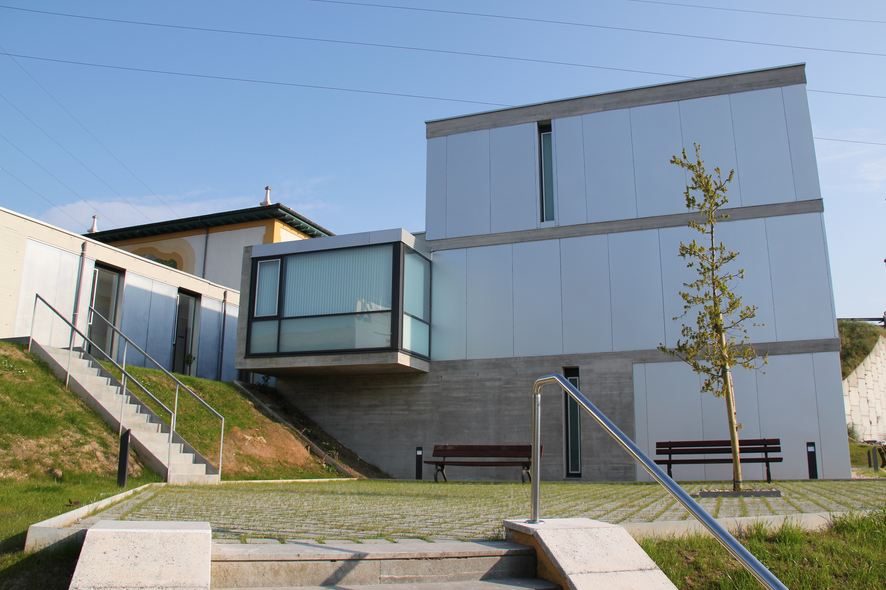
At a glance
- Location: Barreda, Torrelavega
- Type: Municipal archive, historical records and local press
- Address: Avenida de Solvay, no number, beside Colonia de La Palmera
- Access: Consultation by request and subject to document-access rules
- Telephone: 942 881 579
Torrelavega’s Municipal Archive preserves administrative and historical records together with local and regional newspapers. It is on Avenida de Solvay in Barreda, beside Colonia de La Palmera. Check the required procedure and access conditions before requesting a consultation.
Manuel Rotella Gómez Municipal Archive and Newspaper Library
The municipal archive and its newspaper library are on Avenida de Solvay, without a street number, in Barreda, next to Colonia de La Palmera. The official town council page describes the facility as the service that preserves municipal records and makes them available, subject to the rules, to residents, researchers and the administration itself. Spain’s Censo-Guía of archives records the parallel name “Archivo Municipal-Hemeroteca Manuel Rotella Gómez” and gives the same location. The council’s published telephone number is 942 881 579.
This is not a museum for casual drop-in visits or a conventional exhibition gallery. Its main purpose is to preserve records, provide supervised consultation under applicable rules, support municipal administration and enable research. It may be especially useful to people studying Torrelavega’s history, seeking administrative documentation or looking for local newspapers. Before travelling, identify the type of consultation you need and check whether an application is required: access depends on the document and the purpose of the request.
A municipal service with a long history
The town council points to references in municipal minutes from 1763 concerning the need to preserve an archive. In 1887, according to its institutional account, the council was already asking committees that removed files from the secretary’s office to leave a receipt. These references show an early concern for document control; they do not mean that today’s archive existed then as a building or as an organised service in its present form.
The institution now known as the Municipal Archive began to take shape in 1985, when a technical post covering archives, libraries and museums was filled. The town council credits that professional with organising the collections and giving the service a structure. In its early years, documents were spread across different premises, including the Municipal Palace. In 1993, as the volume grew, historical records from before 1963 moved to the lower floors of the former El Carmen sanatorium, while the central and intermediate sections remained in municipal offices.
The condition of the El Carmen building led to its evacuation. In 2000, the historical collections were moved temporarily to former Solvay company schools made available to the council. The Newspaper Library followed a separate path: the council says it first operated at El Carmen, then moved to the former Solvay schools, and reopened to the public in the former SNIACE Casino in 2006. This explains why older news reports describe the archive and newspaper library as being in the “former SNIACE Casino”.
The central, intermediate and historical sections were brought together in 2010, when a purpose-built Municipal Archive opened beside the restored remains of the old casino. The current site should be understood as a complex with different buildings and stages: the rehabilitated former casino and a new archive building. The municipal source does not assign one construction date or a single architectural style to the entire complex.
What the Municipal Archive preserves
The principal collection consists of records created by Torrelavega Town Council in carrying out its duties. Examples listed by the council include building permits and plans, business-opening licences, cemetery plot concessions and historic population registers. These records can have administrative and legal value for residents, property owners, professionals and public services, as well as helping researchers study how the municipality’s urban fabric and society have changed.
Other collections were added by donation or deposit and were not produced by the council. The published list includes material from the Prometeo Cultural Association, Librería Puntal bookshop, Archivo General Castañeda, the former Viérnoles Town Council, the Fernández Escalante family and the Teira Collection. The national Censo-Guía also records collections and fonds linked to local people, associations and organisations. These broaden the scope for research, although not every item is necessarily catalogued online or available without an application.
The council names collections associated with Ricardo Bueno, Teira, Ezequiel López, Aurelio García Cantalapiedra, Ruiz Martínez and Luis Alberto Salcines, among others. It also notes that the Teira Library includes material dating from the 17th to the 20th centuries. The existence of a specialist collection does not mean that every item is on display or digitised: many materials are consulted in the reading room or must be requested from staff. For a research project, it helps to identify the collection, dates and subject in advance.
Access to records is governed by public-service principles, preservation needs and legal protections. The Censo-Guía describes free access for people over 18 and minors accompanied by an adult, subject to limits related to conservation, personal and family data and security. The town council distinguishes administrative and technical requests from historical research. Certain files, projects and plans may require proof that the applicant is an interested party, the relevant authorisation or an explanation of the research purpose. These rules protect records that may contain private or sensitive information.
The Newspaper Library and Torrelavega’s press
The Newspaper Library has a historical connection with the Gabino Teira Municipal Library. The town council explains that it was incorporated into the archive because of a lack of space. It preserves local and regional newspapers and magazines dating back to the 19th century, alongside publications with different frequencies and readerships. Titles named by the council include El Adalid, El Impulsor, El Cántabro, El Cantábrico, El Dobra, El Eco del Besaya, El Eco Montañés, El Heraldo Montañés, Hidalguía Cántabra and El Liberal Montañés.
The collection also includes long-running regional newspapers such as El Diario Montañés and Alerta. The town council says that daily newspapers are available up to the year before the current one. This describes the collections announced by the institution; it does not guarantee that every issue is complete, digitised or available online. If you need a particular date, publication or article, ask staff which runs and issues have been preserved and whether they must be reserved.
Historical newspapers can help trace changes in neighbourhoods, public works, associations, festivals, businesses, labour disputes and everyday life. To interpret an article, consider its publication date, editorial context and the difference between contemporary reporting and later recollections. The Newspaper Library provides material for this kind of study; this guide does not reproduce specific articles or claims without consulting the original issue.
How to request a consultation
The town council handles administrative and historical consultations differently. Anyone who needs documents for submission to another public body should follow the municipal application process and, where relevant, establish their connection to a property or community. Professionals consulting plans for a commission may need to submit a request and, when applicable, authorisation from the owner or community. The council says that requests can be started in person at the Municipal Registry or through its Electronic Office, depending on the case.
Researchers and students should complete the historical-consultation application. The council asks students to include a letter from the teacher or supervisor responsible for the research. Applications can be filed at the Municipal Registry or through the Electronic Office. Check the current forms and requirements before visiting, since administrative procedures may change and some documents need preparation or prior permission.
The town council describes study rooms with computers and parking at the facility. This is not a guarantee that a desk, computer or parking space will be available immediately. If your visit depends on these services, call 942 881 579 first. The municipal page consulted does not publish regular public opening hours, so this guide does not reuse schedules from old reports or from the former location.
An archive in Barreda’s industrial landscape
The Avenida de Solvay location connects this records service with Barreda’s industrial and residential history. The archive is in an area associated with SNIACE and the neighbourhoods of La Palmera and El Salvador. The nearby former casino recalls social life linked to the factory, while the purpose-built archive responds to the needs of storage, preservation and consultation. These are distinct elements within one urban setting and should not be confused with operating factories or restricted industrial premises.
The archive can be part of a themed visit about Barreda and Torrelavega’s industrial past, but consulting its records is not a guided tour of the casino or the former SNIACE facilities. The town council presents a records service and its work spaces; it does not advertise an open architectural tour. If your main interest is the industrial heritage outside, check each site separately and respect current entrances, fences and uses.
The council has described the archive as one of its key municipal facilities for preserving local heritage and has taken part in archive events highlighting the work of its technical staff. These reports provide context for the service’s cultural role; they do not replace archival catalogues or describe every current activity. The best way to prepare research is to define the documentary question and ask the archive for guidance.
Before you go
The published address is Avenida de Solvay, s/n, beside Colonia de La Palmera in Barreda. The town council directory gives the telephone number 942 881 579; the national Censo-Guía places the archive in the same area and also provides coordinates. The municipal page does not publish general opening hours or advertise spontaneous visits as a tourist activity. Contact the service in advance to confirm opening, application steps, required documents and whether the material you need is available.
Free entry to a consultation room does not mean that every file can be read without restrictions. Personal data, preservation, third-party rights and security may limit access. Some requests require evidence of legitimate interest or supporting authorisations. Archive staff can explain which parts of a collection are accessible, whether a consultation copy exists and whether an appointment is needed.
Visitors without a specific research request may find it more useful to explore Barreda’s streets and view the former casino and workers’ colonies from public areas. Do not enter storage rooms or work areas without permission, and do not photograph documents containing personal data. For research, checking the requirements in advance makes better use of the journey and avoids mistaking the archive for a continuously open museum.
Scope and sources for this guide
The institutional history, premises and collections described here are based mainly on information published by Torrelavega Town Council. The Ministry of Culture’s Censo-Guía helps confirm the parallel name, address and access conditions recorded for the municipal fonds. A 2011 Europa Press report provides a contemporaneous account of the period when the service was based in the former SNIACE Casino. The chronology here follows the town council’s account, which distinguishes the Newspaper Library’s move in 2006 from the archive sections’ concentration in the new building in 2010.
An archived version of this site’s former page, captured on 26 July 2025, describes the Newspaper Library and consultation room at the former SNIACE Casino and gives opening times that are not treated as current here. The municipal account distinguishes that move from the archive sections’ concentration in the new building in 2010. The archived page cites an archival reference from 1731, while the municipal account consulted here starts in 1763; the difference remains unresolved until the cited minute can be located. Opening, availability and current consultation conditions should be confirmed directly with the service.
More to see in Barreda
This guide is part of Barreda, where you can find other places, routes and celebrations linked to the neighbourhood. You can also return to Torrelavega municipality.
Explore next: Barreda · Torrelavega
Sources:
Torrelavega Town Council · Municipal Historical Archive ↗, Spanish Ministry of Culture · Censo-Guía archive record ↗, Spanish Ministry of Culture · municipal fonds and access rules ↗, Torrelavega Town Council · directory ↗, Europa Press · archive-library at the former SNIACE Casino ↗, Torrelavega Town Council · archive conference and service history ↗, Former Viajar por Cantabria page ↗ and Internet Archive · snapshot of 26 July 2025 ↗.