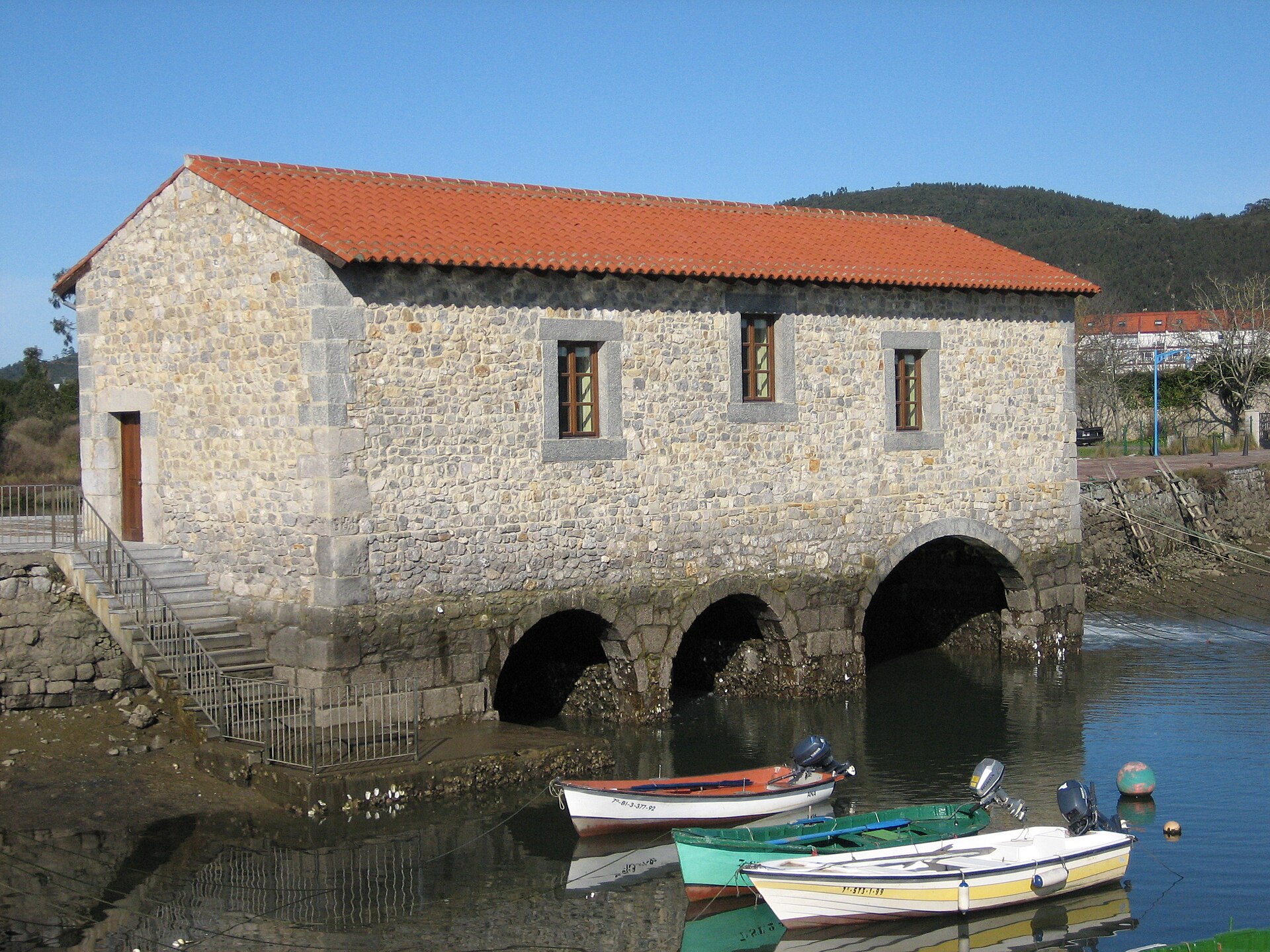
The Jado Mill is a historic tidal mill in the neighbourhood of Ancillo, in Argoños. Restored as an interpretation centre, it explains the marshland and the ways of life shaped by the estuary. Argoños Town Council describes how water stored at high tide was released as the tide fell to drive the milling machinery.
Key facts
| Location | Ancillo, Argoños |
|---|---|
| Municipality | Argoños, Cantabria |
| Type | Industrial heritage and interpretation centre |
| Access | Opening and visits must be confirmed with the town council |
History and how it worked
The tides on the Cantabrian coast fill and empty the estuary twice a day. Tidal mills harnessed this change in water level with a dam or reservoir, gates and water wheels. At high tide, water was retained; when the outside level fell, the stored water was channelled through the mechanism, turning the wheels that powered the millstones. The energy came from the tidal cycle and the difference in water height, rather than from a permanently flowing river.
The town council’s tourist information describes a tidal range of about 80 centimetres during neap tides and up to 4.5 metres during spring tides. These are explanatory figures, not a forecast for a particular date. The actual height varies with the tidal cycle, weather and measurement point. They help explain why the mill could operate only when water conditions allowed, and why a present-day demonstration depends on the tide.
According to the municipality, the cultivation of maize helped tidal mills spread along Cantabrian estuaries from the seventeenth century onwards. Around twenty were counted in the Santoña Bay area, and the council identifies three historic mills in Argoños. This network represents a coastal technology linking grain, water, labour and transport. Jado is one of the mills restored to interpret this history, not the only mill that once existed in the municipality.
An interpretation centre in El Rivero
The building has been restored as a centre about the marshes, nature and the lives of people who settled along the estuary. Its displays connect the mill’s engineering with fishing, shellfish gathering, navigation and estuary biodiversity. In January 2026, the town council described a visitor offer that included 21 model boats, an exhibition about fishing and shellfish-gathering methods, information about birds and two videos: one about maize milling and another about routes in the municipality.
A later municipal report described an educational visit explaining the mill’s operation, the history of navigation through models of boats from different periods, and marshland plants and wildlife. Birds mentioned included herons, cormorants, ducks and the locally named “zapatitos”. That report covers an activity held in August 2026; it does not guarantee that every public visit will follow the same route or include the same guide and material.
The council also locates two sculptures in El Rivero, dedicated to a shellfish gatherer and a batel, a traditional rowing boat associated with the area. The same municipal report connects the boat with an Argoños team that became Spanish champion in 1972. It does not identify the sculptors or installation dates. See the separate sculpture page for those works; the photograph on this page shows the mill itself.
The mill in the estuary landscape
El Rivero is best understood as a network of water, embankments, channels and intertidal land. The estuary changes with the tide: areas covered by water may partly emerge a few hours later. This variation explains both the historic mill’s operation and the need to stay on authorised paths. Do not walk across mudflats or attempt to cross channels or embankments without a marked route. Intertidal ground can be unstable, and water may return before a walk is over.
The municipal “Argoños by the sea” route starts in Ancillo, descends towards Santiuste and continues to El Rivero and the mill. It then crosses an embankment towards a small peninsula with a park and bird observatory. The council gives a circular distance of 800 metres and a duration of 30 minutes. These figures describe the official route but do not confirm the current condition of the surface, universal accessibility, park opening or the tide needed for a mill demonstration. Check the route and conditions on the day.
The surroundings are part of the Santoña, Victoria and Joyel Marshes Natural Park. Older municipal pages sometimes use the term “natural reserve”; this guide uses the current park name and does not repeat older designations without checking them. Follow signs, do not feed birds and avoid using playback calls to attract wildlife.
Booking, opening times and accessibility
Municipal information is not entirely consistent. The mill’s page describes summer opening and says the mechanism is demonstrated when the tide allows. A January 2026 announcement about a new tourist office on Avenida de Trasmiera says guided visits to the mill require advance booking by email. Another tourist listing retains older seasonal details and says visitors are received at the mill, about a 15-minute walk from the office. Because these sources differ, do not rely on an address or time copied from an old page.
Before travelling, confirm whether the centre is open, where to meet, whether a booking is required, the visit’s duration and language, accessibility arrangements and whether the mechanism can be demonstrated that day. Emails previously published for guided-visit enquiries are oficinaturismoargonos@gmail.com and molinodejado@gmail.com; check that they are still active. The municipal information does not specify gradients, path widths, adapted toilets or parking beside the mill, so full accessibility cannot be promised.
A guided indoor visit and an outdoor walk are different experiences. A booking for an activity does not grant access to closed embankments or technical areas. If the tide does not allow a demonstration, the centre may still offer interpretation, but the source does not guarantee which parts will be available. Ask the team before planning your trip.
Frequently asked questions
Does the mill still work?
The town council says that the mechanism is demonstrated when the tide allows. Confirm whether a demonstration is planned for your chosen date.
Do I need to book?
A municipal announcement in January 2026 requested advance booking for guided visits. Check the current procedure with the tourist office.
What can I see besides the machinery?
The municipal visitor offer includes model boats, displays on fishing and shellfish gathering, bird information and interpretive videos. The actual displays available may vary.
More to see in Ancillo
This page is part of the guide to Ancillo. Explore other places, routes and celebrations associated with the settlement:
- Chapel of San Esteban in Ancillo
- Maritime sculptures of El Rivero ES
- Argoños by the sea: Ancillo and El Rivero ES
- San Esteban celebrations in Ancillo ES
- Ancillo ES
- Argoños municipality
Sources: Consult source ↗, Consult source ↗, Consult source ↗, Consult source ↗.