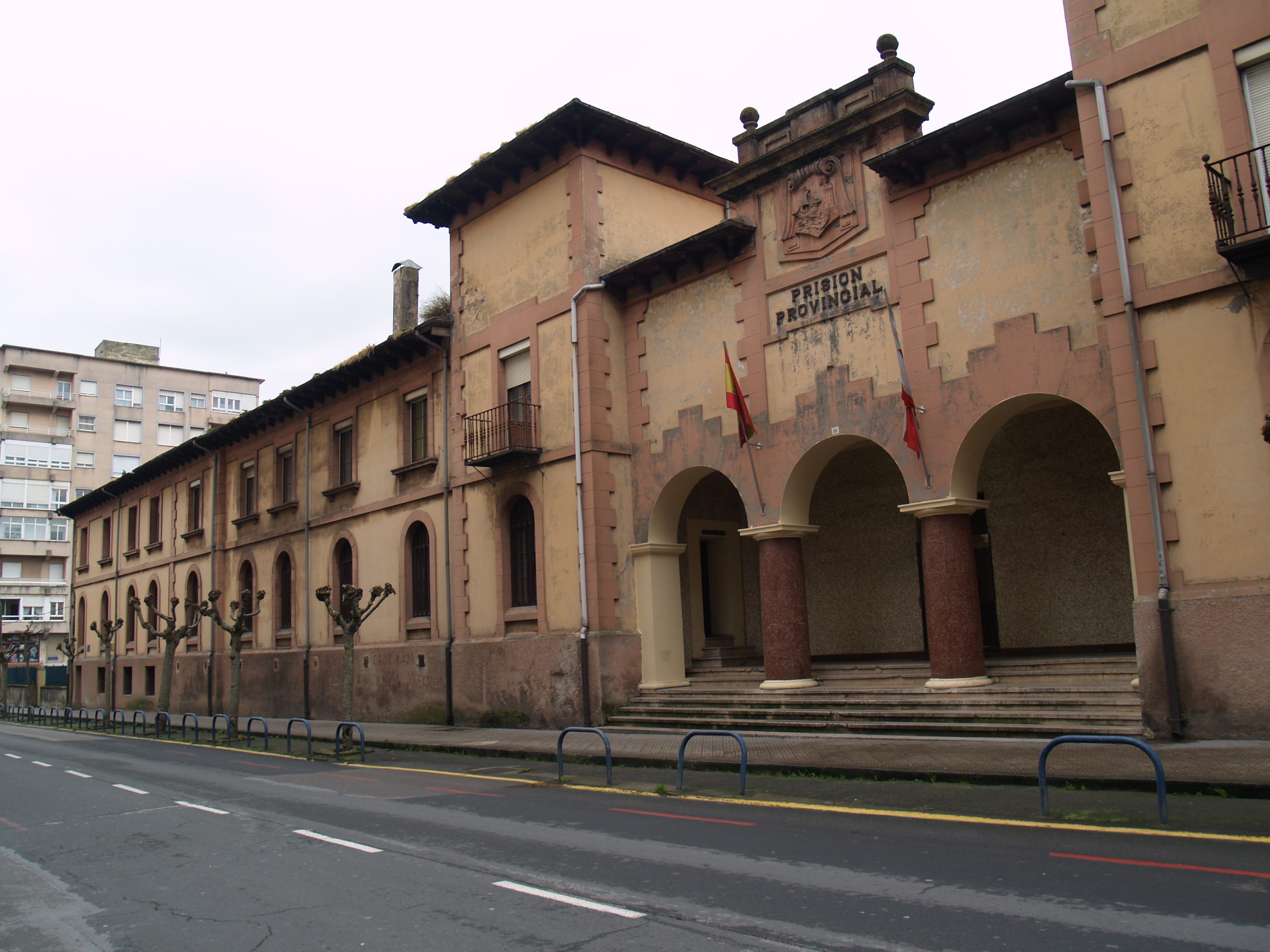
The former prison on Calle Alta no longer exists: its site is now a car park, on land once occupied by San Fernando cemetery.
Essential information
| Locality | Santander |
|---|---|
| Municipality | Santander |
| Type | Heritage |
| Visit | Exterior only; confirm any indoor access |
History and significance
The plot at 95 Calle Alta links three successive urban landscapes: San Fernando cemetery, the Provincial Prison and today’s car park. In 2018, the City Council identified the address and the site’s land registry history, and confirmed that the prison building had been demolished.
A Santander site with several lives
Santander’s former Provincial Prison stood at number 95 Calle Alta, on a plot beside the slope overlooking the lower city. The building has not survived: the site is now occupied by a car park. This guide is therefore about a vanished historic place and the changes that took place on the same land, not a prison open to the public or a monument that can be visited inside.
The City Council’s 2018 documentation makes it possible to locate the building precisely. The urban planning agreement from that year identified the plot as 95 Calle Alta and recorded an area of approximately 8,983.80 square metres, based on a topographical survey. It also explained that the site came from part of the closed San Fernando cemetery, once set aside for a new prison. The municipal document confirmed that the prison building had already been demolished.
This sequence gives the place its particular character: beneath today’s car park lie the overlapping memories of the cemetery, the prison and changing urban plans. This does not mean that all physical remains have been preserved. The documents allow us to reconstruct the uses of the plot, but do not establish which traces, if any, remain underground or where they might be found.
Before the prison: San Fernando cemetery
In the nineteenth century, San Fernando cemetery—also known as Santa Cruz cemetery—occupied the Calzadas Altas. Its creation was connected with changing burial practices and public health measures that encouraged cemeteries outside churches. The official Ciriego cemetery website places San Fernando on the Calzadas Altas, along the route now followed by Calle Alta, and says it remained in use into the early decades of the twentieth century.
The sources do not give a single, settled date for the cemetery’s beginnings. José Simón Cabarga’s book Santander: A History of Its Streets places the first burials in 1830; a September 2026 report says it was inaugurated in 1832. The arrival of the first burials should be distinguished from a possible official opening date. The information available here is not enough to resolve the difference with certainty.
Accounts also differ on the cemetery’s replacement and final closure. Ciriego’s institutional history says San Fernando remained in use into the early twentieth century; Cabarga’s book links its closure to the construction of the new cemetery. Ciriego’s official website dates the new cemetery’s inauguration to 3 September 1885, while the report provided cites 1893. We cannot explain the discrepancy from the sources at hand, or assume that the new cemetery’s opening and the end of all burials at San Fernando were the same event.
The change of cemetery did not immediately erase the earlier funerary landscape. The recent report recalls that some monuments and remains were moved to Ciriego, but not every family was able to do so. According to that report, the possibility of human remains being found during future works has not been ruled out. This is a possibility to treat with care, not confirmation that remains have been located or that an archaeological excavation has taken place on the plot.
A provincial prison planned during the Second Republic
The former prison replaced an earlier penitentiary housed elsewhere: the Casa de Recogidas de Santa María Egipciaca, near today’s Cabildo de Arriba. A municipal guide to the Way of St James through Santander explains that the house was used as a prison from 1819 until the Provincial Prison on Calle Alta was built. The prison on this site should not be confused with the remains of Santa María Egipciaca, which are in another part of the city.
The project for the new Provincial Prison was approved and put out to tender in 1931. However, the construction timeline means that 1931 should not be presented as its opening date: newspapers were still describing the building as under construction in December 1934 and expected it to enter service a few months later. José Simón Cabarga gives 1935 as the year of its inauguration. This is the date best supported by the references consulted, although no handover record or exact date of the first inmates’ arrival has been located here.
The distinction matters because approval of the project, the start or progress of construction, and the actual opening are separate milestones. Documents published in 1931 record a state initiative to replace the older facilities. They do not, by themselves, prove who designed the building: secondary references attribute it to particular architects, but the signed plans have not been checked. This guide therefore does not name a specific architect.
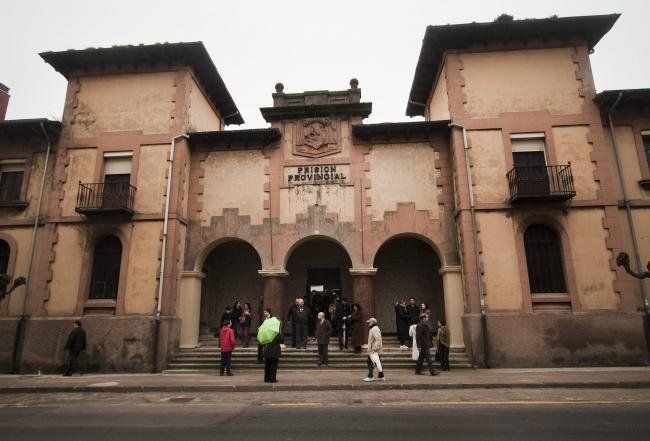
The photographs accompanying this page show the façade and entrance of the demolished prison. They help identify the building and its sign, but are not enough to reconstruct the layout of the cells, courtyards or interior services. No precise date is assigned to the photographs because no documentary caption confirming it has been found.
Prison memory: a careful account
The prison operated through different political and legal periods, from the Second Republic to democracy. The fact that the same building functioned for decades does not mean those periods were alike, or that their rules, responsibilities and experiences can be reduced to a single label. During the Civil War and the post-war years, Santander had several places of detention. Historical memory sources list them separately; attributing events at Tabacalera, the Alcázar, Las Salesas, the Oblatas or other centres to the Calle Alta prison would distort the history of each site.
The PARES catalogue preserves references to records from Santander’s Provincial Prison dated 1936 and 1937, including files concerning accounts and healthcare. These are leads for further research, not a complete list of prisoners or proof of the circumstances of any individual case. Names, life histories and responsibilities require person-specific documents checked against other sources.
Prison history can also be approached through everyday life: admission, visits, work, the infirmary and the prison shop. A published account of a stay in 1973 offers one personal experience from that particular moment; it should not automatically be generalised to all inmates or earlier decades. More archival material remains to be studied. In 2024, the Ministry of Culture reported the continuation of a project to digitise personal files of inmates in Santander from 1933 to 1974, a way to broaden understanding through primary sources.
Remembering a prison means paying attention both to the institution and to the people who passed through it. Documentary caution does not diminish the importance of memory; it helps connect names, dates and events to the right building. Cantabria’s Historical and Democratic Memory Act includes the Provincial Prison among the places of detention that should be understood within a wider geography of repression, without collapsing them into a single site.
Closure, demolition and conversion into a car park
Order INT/1878/2009 created the José Hierro del Real Social Insertion Centre and provided for the closure of Santander’s prison. The same order allowed the establishment to continue operating temporarily as a women’s unit under El Dueso. For that reason, 2009 marks the official closure decision, but not necessarily the last day of activity in every part of the prison.
The building disappeared later. Reports from 2010 placed the start of demolition works in that year; the work was carried out in stages. By 2018, an agreement between the City Council and the state company that owned the site described the plot as clear of buildings. The car park that stands there today was created after the demolition. The visible feature along this stretch of Calle Alta is the plot, not the prison.
The 2018 municipal documents also recorded the planned land use for the area: residential use, with the possibility of commercial or other tertiary uses on ground floors. The agreement distinguished the state-owned plot from a privately owned property included in the scheme. These details help explain why the site’s future depends on agreements and planning procedures, not simply on a decision to build a new facility.
The recent proposal for the site
A report published by El Diario Montañés on 6 September 2026 says that a plan has been proposed to build an underground car park on the former prison plot and develop housing there as well. It reports that the temporary car park has 317 spaces and that nearby residents want any alternative to retain at least that capacity and remain free of charge. This is a request from residents, not an approved condition of the project.
According to the report, the state-owned company Siepse had revived discussions after resolving the acquisition of the whole site. The plan mentioned housing promoted by different public bodies: 55 affordable homes from the municipality and 44 planned by Siepse. The article also stated that there was still no building permit and that several steps remained before the project could be delivered. These figures therefore describe the proposal reported in September 2026, not completed homes or works under way.
The current debate has brought the less visible history of the place back into focus: there was a cemetery before the prison, and a prison before the car park. The possibility of finding remains during excavation adds a heritage dimension and calls for respect towards those buried there. If the project moves forward, the necessary permits and studies will need to clarify how that memory is protected and what action should be taken if anything is found. The sources consulted do not show that works have begun or that remains have been discovered on this site.
What can be seen today
The Provincial Prison building is no longer standing. From the street, visitors can see the plot and the current car park; historic photographs make it possible to compare the site with the former façade. If you visit the area, treat it as part of an urban walk and respect parking areas, entrances and vehicle movements. No exhibition, interpretation centre or interior tour of the former prison is currently advertised.
Calle Alta contains other buildings with their own histories. The former San Rafael Hospital, now the seat of the Parliament of Cantabria, is a short distance away, as is the former convent of Santa Cruz, later associated with the Tobacco Factory. They have separate guides because their buildings and histories should not be confused with the prison or the former San Fernando cemetery.
A visit can help you read an urban transformation, rather than look for a surviving monument. An old photograph, map or municipal document explains this place better than the car park’s present appearance. The site’s history invites a closer look at Santander’s changing uses of land, while leaving open questions that only archives, archaeology and future planning can answer.
Plan your visit
There is no building to visit. The reference point is the site now occupied by the car park on Calle Alta; it can be viewed from public space without entering restricted areas. The underground car park and housing are proposals described in the press in September 2026, not confirmed construction or an attraction open to visitors.
Nearby
This site is in Santander city guide, within the municipality of Santander. The locality guide brings together its entries so you can continue exploring the area.
Frequently asked questions
Can you visit inside?
No. The prison building has been demolished and no interior visit is available. This guide distinguishes what can be seen from outside from an organised visit.
More places in Santander
- Cathedral of Our Lady of the Assumption (Spanish page)
- Former San Rafael Hospital and Parliament of Cantabria (Spanish page)
- Convent of Santa Cruz (Spanish page)
Sources: Santander on the Way of St James ↗; Ciriego Cemetery history ↗; José Simón Cabarga, Santander: A History of Its Streets ↗; Official State Gazette, Order INT/1878/2009 ↗; Cantabrian Historical and Democratic Memory Act ↗; PARES catalogue ↗; Por Santander: the prison that left an empty site on Calle Alta ↗; and El Diario Montañés, 6 September 2026 ↗.