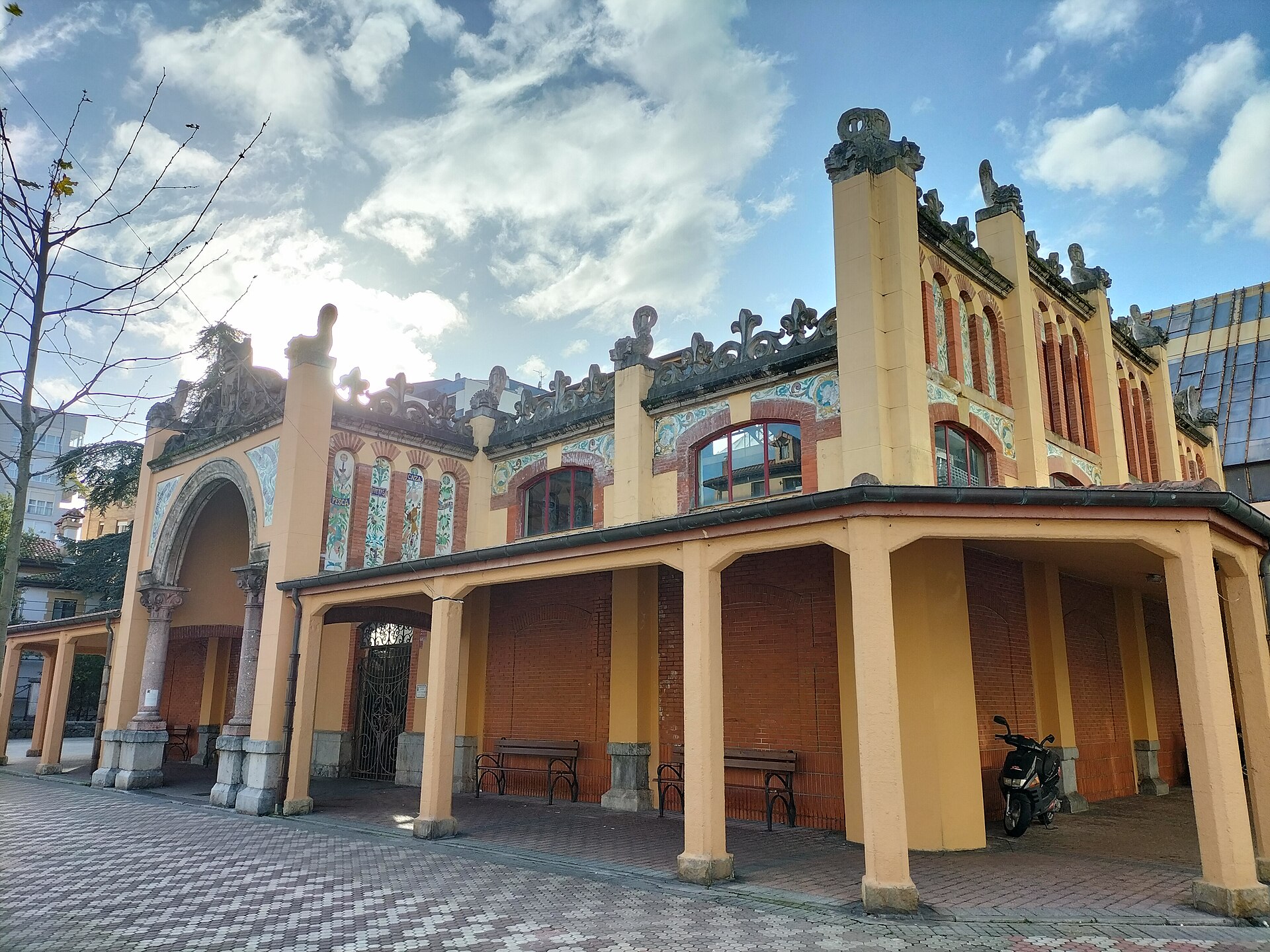
Laredo’s historic fish market is recognised by Daniel Zuloaga ceramics and its modernist architecture.
Key facts
| Place | Laredo |
|---|---|
| Municipality | Laredo |
| Type | Heritage |
| Access | Exterior; check whether interiors can be visited |
History and features
The Town Council dates the Food Market to the early years of the twentieth century, around 1900, and identifies it as the popular fish market. Located on Menéndez Pelayo Street, the building has been listed in Cantabria’s General Inventory of Cultural Heritage since 2002. Its design combines modernist and eclectic features in a market layout that opens onto arcades.
The glazed ceramic decoration, attributed by the Town Council to Daniel Zuloaga, is one of its most distinctive features: niches with animal-head motifs, fish, fruit and vegetables, framed by exposed brick. The decoration brings the building’s everyday purpose onto its façade and helps explain why the market is part of Laredo’s civil-architecture route.
The municipal phrase “a floor that was enclosed in 1914” refers to the creation of enclosed stalls under architect Emilio de la Torriente’s project; it does not mean the market stopped operating. A 2024 municipal bylaw describes refurbishment carried out during part of 2023 and 2024, the addition of a Camino de Santiago pilgrim information office and a new arrangement of the stalls. The bylaw envisaged six sales stalls as the final number after the works. That forecast does not establish how many are open today or what each one sells.
According to the bylaw published in Cantabria’s Official Gazette, the market continues to operate as a municipal retail venue for food and flowers. The same regulation gives its address as 5 Menéndez Pelayo Street and provides for outdoor stalls under the arcades or in the pedestrian area of Escultor José Grajera Street. Check current opening times and activity with the Town Council before planning a visit: older tourism pages list products and arrangements that may have changed after the refurbishment. This is an operating market, not a museum with permanent guided tours. Keep entrances clear and respect traders, pilgrims and customers.
The bylaw distinguishes permanent stalls from seasonal or daily ones, and lists the activities that may be authorised: fish, meat, fruit and vegetables, bakery, food retail and floristry. This describes uses the Town Council may authorise, not a current directory of businesses. It also allows outdoor stalls under the arcades and in the pedestrian area of Escultor José Grajera Street; this provision does not guarantee that outdoor sales take place every day.
The building combines a functional market structure with decorative elements inspired by Neo-Mudéjar architecture. Laredo Turismo highlights the exposed brick, ceramics, stone and ashlar corners, as well as overlapping arches and interlaced motifs. Ceramic pieces depict animals and goods associated with market sales, making the building’s purpose legible from the street. A study of Cantabria’s food heritage also connects the market’s decoration with the food once sold inside.
The sources do not give one date using the same criteria. The Town Council places the building around 1900; Gerardo J. Cueto Alonso’s study dates Eladio Laredo’s project to 1902, while press reports have pointed to the inscription “1903” on a ceramic frieze. These dates may refer to different stages of design and construction, but the sources reviewed do not establish the chronology with certainty. It is therefore more accurate to describe the market as an early twentieth-century building and retain each specific date as attributed by its source.
The 1914 date also needs context. The municipal heritage description says that a floor of stalls was enclosed at that time as part of architect Emilio de la Torriente’s intervention. It does not refer to the closure of the market or prove that the building remained unused. The change shows that the interior was adapted to commercial needs over time, although the material available here does not include a complete historic plan that would allow each interior phase to be reconstructed.
Since 2002 the building has been included in Cantabria’s General Inventory of Cultural Heritage, according to the Town Council. This recognition should not be confused with an individual declaration as an Asset of Cultural Interest. The market matters both for its architecture and for the continuity of an urban service: the covered market connects local trade with Laredo’s fishing identity and the public space beneath its arcades.
The most recent refurbishment took place in 2023 and 2024. The municipal bylaw describes the rearrangement of the interior and the addition of a pilgrim information service. The company that carried out the works reports repairs to roofs, façades, paving and ceilings, as well as a new internal layout with stalls of different sizes and accessible facilities. Before work began, the municipal proposal referred to four large stalls and two small ones; this forecast is not a substitute for checking the market’s current operation or the number of traders.
While the works were under way, a heritage association reported in December 2023 that pieces of a ceramic frieze bearing the inscription “1903” had fallen and broken. This is recorded as a complaint published at the time, not as an independent survey of the building’s present condition or evidence that all the decoration was lost. The refurbishment sources reviewed describe work on several surfaces but do not specify whether that frieze was restored. If the condition of the ceramics matters to your visit, check the latest information from the Town Council.
The simplest visit is to view the arcades and façade from public streets, including the market on a walk through the urban architecture of Menéndez Pelayo Street and the historic-centre area. Interior access may depend on trading activity, service hours and occasional works. Do not assume that the building functions as an exhibition hall or that every area is open to the public. If you intend to shop, check the current municipal opening times; if you only want to take photographs, avoid blocking entrances, stalls or customers.
Plan your visit
The building can be seen from public space. Confirm the municipal market’s current hours and activity before setting out; the number of stalls in the bylaw is a forecast, not a current count.
Access
Being able to view a building from outside does not mean that it is open to the public. Check its current use and respect private property.
More to see in Laredo
This page is part of the Laredo guide. Find the other places, routes and celebrations associated with this neighbourhood there.
- Villota or Gutiérrez Rada Tower-House in Laredo ES
- Villota del Hoyo or Revellón Tower-House in Laredo ES
- House of Hernando de Alvarado in Laredo ES
- La Baja Cave in Laredo ES
Return to Laredo ES or explore the whole municipality of Laredo.
Sources: View source ↗, View source ↗, View source ↗, View source ↗, View source ↗, View source ↗, View source ↗, View source ↗ and View source ↗.